It usually starts the same way.
You're a few kilometres into a run along the Burleigh beachfront or the Tallebudgera Creek path, and a sharp pain shows up on the outside of your knee. Sometimes it's the outside of your hip.
You stop, it eases off. You start again, and it's back within minutes.
You've been told it's your IT band. So you've stretched it, had it massaged, taped it, done your clams and side planks, and been told to shorten your stride and lift your cadence.
It still comes back at the same point in every run.
That's because the IT band is where you feel the problem. It isn't where the problem starts.
The Symptom Isn't the System
Pain is a symptom. It's your body telling you that something in the system isn't working, and it usually shows up wherever your body has been compensating the longest.
Most IT band advice treats the symptom. Stretch the sore band, massage it, strengthen the one hip muscle next to it, change one number on your watch. Each of those can take the edge off for a while. None of them change how your whole body organises itself every time your foot hits the ground.
And as a runner, your foot hits the ground thousands of times per run.
Your Body Is a Tensegrity Structure
Your bones aren't stacked on top of each other like blocks. They're held in space by a continuous web of tension made up of muscle and fascia. This is called biotensegrity.
When that tension is balanced, the load from each stride spreads across the whole body. When it isn't, load piles up in one area.
The IT band is one section of that web. Through the fascia, it's connected to your glutes, your trunk, and across your back to the opposite shoulder and arm. Your glute and the opposite lat are linked in a sling that's designed to work together every time you take a step.
So when the outside of your leg is overloaded, the question isn't "how do I loosen my IT band?"
It's "why is my body dumping load there?"
What It Looks Like When You Run
When we film runners who have IT band pain, a few things tend to stand out:
- The hips jar on landing. The pelvis drops, shifts or twists as each foot hits the ground, instead of staying stable over the stance leg.
- The upper body isn't contributing. The ribcage doesn't counter-rotate against the pelvis, and the arms hang, stiffen or swing across the body instead of driving the stride.
- The trunk isn't stable. Without good pressure through the core, the spine and pelvis have nothing solid to work from, so the hip and thigh grip to hold you up.
When the cross-body slings aren't doing their job, the outside of the hip and thigh tighten up to create the stability that's missing. That tightness is your body stabilising itself. It isn't a fault to be stretched away.
Why the Usual Fixes Keep Failing
Stretching. If the tightness is there to stabilise you, stretching it removes that stability without fixing what made it necessary. Over-lengthened tissue doesn't contract as well, so more load ends up on your tendons and ligaments. The body tightens back up, often by your next run.
Clams, side planks and glute activation drills. These work one muscle on its own, lying on the floor. Running asks every muscle to work together, standing on one leg, while rotating. Strength built in isolation doesn't show up in your stride.
Massage, massage guns and taping. They can change how the area feels for a few hours. They don't change the pattern that keeps loading it.
Forcing a cadence. Making yourself take more steps per minute changes one number while the mechanics underneath stay the same. The body compensates somewhere else to hit the target. When your mechanics improve, a more efficient rhythm tends to follow on its own.
How Functional Patterns Fixes It
Functional Patterns is built around the movements the human body evolved to do: standing, walking, running and throwing. We call them the FP First Four. Running is one of them, so we don't treat your running as the enemy. We fix how you do it.
1. Assess the whole pattern
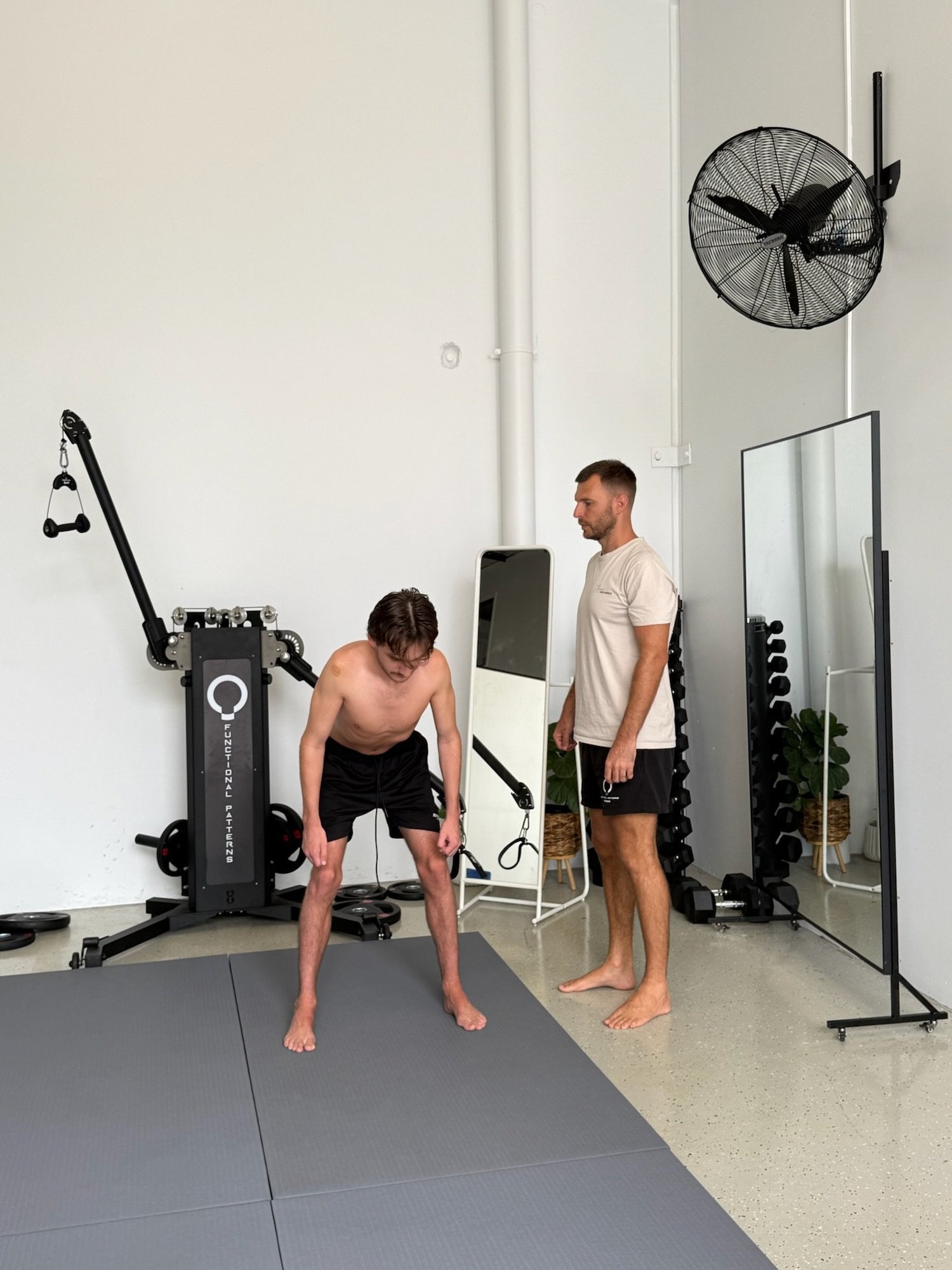
We take posture photos and film your gait on the treadmill. This shows us where force is leaking through your body, which is often a long way from where it hurts. It also gives you a baseline to compare against as you progress.
2. Release what's restricted
Myofascial release uses slow, sustained pressure with a ball, not passive stretching, to free up stuck tissue around the glutes, hamstrings, TFL and IT band. It rehydrates the fascia without overstretching your ligaments, so the muscles around the hip can start contributing again.
Release on its own won't last, though. The fascia keeps reshaping itself around how you move. That's why the next steps matter.
3. Reposition and stabilise
Next comes building core pressure, stacking your joints, and spreading your weight evenly between your feet. This gives your pelvis a stable base, so your hips don't have to brace every time you land.
4. Train the body as one system
We use integrated, contralateral exercises like the contralateral step row and one-arm step press. In these, one arm and the opposite leg work together under load, with the ribcage rotating against the pelvis, just like they do when you run. These exercises connect the glute to the opposite side of your back so the slings take the load, not the outside of your leg.
From there, we progress from standing and walking into running until your stride holds the new pattern without you thinking about it.
A note on running in the meantime
If your IT band is flaring up, we may ask you to cut back or pause your running for a while. Every run with the old pattern reinforces the old pattern. Giving your body a break while we rebuild your mechanics means you get back to running sooner, with a stride that doesn't break down.
Run Without the Outer-Knee Pain
You don't need another stretch, another clam, or another foam roller.
You need your whole body sharing the load of every stride.
Learn more about our running biomechanics program, see how Functional Patterns works, or read how we approach knee pain.
Ready to find out what's really driving your IT band pain? Book your Running Assessment.